
July 11, 2025, by Brigitte Nerlich
Heat dome: Atmosphere, architecture and agency
The phrase ‘heat dome’ has been around since the 1960s, according to the Oxford English Dictionary. But only recently has it gained currency as one of the many new (extreme) weather words signalling climate change. I first came across it in 2020 when I read reports on a horrible heat wave in India. At that point this was still a distant and exotic phenomenon, like climate change once was, about twenty years ago. That all has changed.
The Royal Meteorological Society defines a heat dome as follows: “a heat dome is created when an area of high pressure stays over the same area for days or even weeks, trapping very warm air underneath – rather like a lid on a pot.”
At the end of June/beginning of July Europe, including the UK, experienced a prolonged heat dome which led to heat waves, wildfires and droughts. On 4 July I read somewhere that that heat dome had ‘collapsed’. That woke me from my metaphorical slumber – and the more I looked, the more metaphorical tentacles I found stretching out from the phrase ‘heat dome’.
Metaphors involve thinking and talking about one thing in terms of another, based on the systematic, but always partial, mapping of some aspects of knowledge or information from a more familiar source domain onto a less familiar target domain. The target domain in this instance is the ‘heat dome’. I shall explore a number of source domains used to talk about it, from architecture to agency.
Atmosphere and architecture
Architectural metaphors are not unusual when talking about the atmosphere and even about climate change itself.
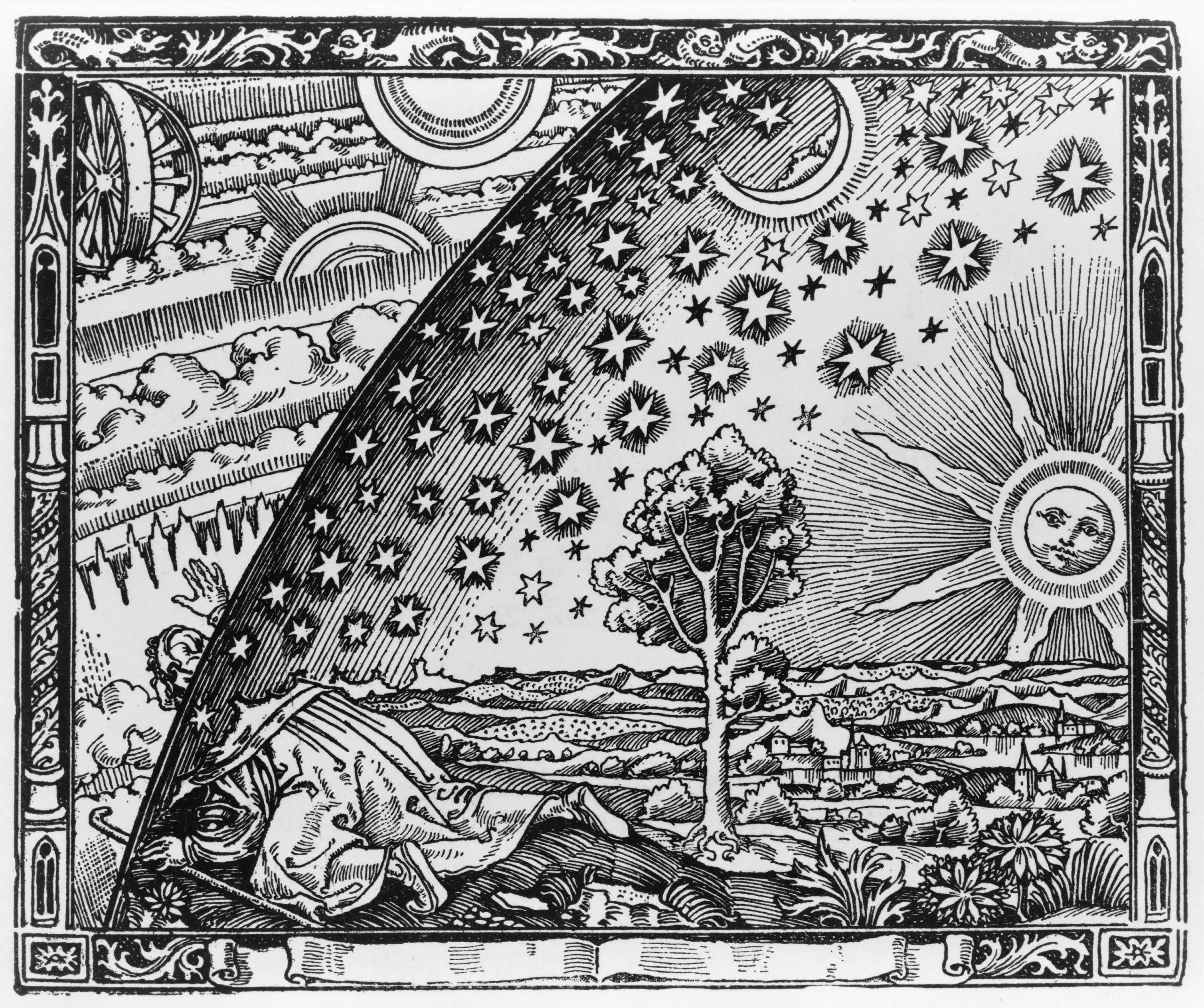
In 1888 Camille Flammarion published a popular science book on the atmosphere and on meteorology entitled L’atmosphère: Météorologie Populaire. This book contained a famous wood engraving of a traveller piercing through the vault of the sky to glimpse the celestial machinery beyond, sometimes called the ‘world dome’*. This was not the only time in the 19th century that the atmosphere led to architectural imaginings.
The greenhouse effect describes how the earth’s atmosphere ‘traps’ heat, something made worse by the addition of greenhouse gases like carbon dioxide, and how this contributes to global warming/climate change. This began to be discussed early in the 19th century. The first metaphorical attestation of the greenhouse effect can be found in a geological magazine published in 1867 where the atmosphere is compared to “an immense dome of glass” and “a great Orchid-house” (OED, online). In 1907, J. H. Poynting used the words “blanketing effect” and “greenhouse effect” (ibid.), with “blanket” being something like a subsidiary metaphor to greenhouse.
In 1969 a US technical report first used the term ‘heat dome’ and said: “The heat dome for Buffalo and Niagara Falls..causes warmer temperatures in the city proper, especially in high density areas”.
Nowadays the term refers to “an area of high-pressure air in the atmosphere which gets stuck in place over a region because atmospheric dynamics around it block it from moving. It works like putting a lid on a boiling pot. The high-pressure system traps hot air below it, which heats up and compresses to form a ‘dome’.”
The heat ‘dome’ is yet another architectural representation of atmospheric phenomena and makes a complex issue more accessible to our understanding through vivid imagery. As in the famous engraving, the sky is metaphorically represented as a tangible, structured boundary.
Atmosphere and coverings
Just as the greenhouse effect is sometimes compared to a blanket, so the heat dome is also compared to a variety of coverings, from blankets, to lids to caps. As we have seen, it is often described as being like a lid on a boiling pot of water. These are all static images of structure, architecture and cover. There are more dynamic framings too though – even ‘blanket’ can become active as in “Massive Heat Dome Blankets Millions Across US”.
After having explored some of the static metaphorical framings of the heat dome, I’ll now examine some of the more dynamic ones.
Atmosphere and agency
The most central metaphor shaping the image of the heat dome is a containment metaphor linked to the dome or lid or cap image: the heat dome ‘traps’ high-pressure air in one place. The trapping of heat can then lead to ‘powering’ heatwaves and ‘suppressing’ clouds and rain.
The fact that this high-pressure system stays in one place is framed by various motion (or rather lack of motion) metaphors. There is talk of the heat dome ‘parking’ over a region, of sitting above a region, of lingering over a region, of settling, and a bit more passively still stalling or getting stuck.
Physical violence metaphors, in turn, are used to say that the heat dome is ‘engulfing’ vast swathes of a country, and even more brutally that the heat dome is ‘hitting’ or striking or ‘gripping’ a country.
But what does a heat dome do once it’s in position and has gripped a country? The dome or lid or blanket or cap turns into an ‘oven‘ that ‘roasts’ and ‘bakes’ what’s in it. “The pressure traps the hot air like the dome of a pizza oven, baking the air and surface underneath.” Or: “If you’ve made grilled cheese in a pan and you put a lid on there, it melts the cheese faster because the lid helps trap the heat”, said an expert on NPR. It also suffocates and stifles people and animals.
All these metaphors turn the heat dome into a living, breathing and acting entity. It even has a life cycle. It gathers strength, but it also weakens over time and it finally ‘collapses’ and dies.
That might not be good news though, as this collapse can be followed by other extreme weather events, such as floods and wildfires. Just after I had read about the collapse of the heat dome, I got news from Germany that my hometown of Stolberg had been quite badly hit by severe thunderstorms and very heavy rain – not as bad as in 2021 but still. And then the news about the floods in Texas came in…..
Conclusion
The heat dome stands in a long tradition of cosmological and atmospheric thinking, from the crystalline celestial spheres of Antiquity to Flammarion’s popularisation of the atmosphere to increasing knowledge of the greenhouse or orchid house effect that is at the root of many modern-day heat domes.
When I read about the collapsing heat dome and its aftermaths, I had this vivid image of Flammarion’s world dome collapsing in on itself. It made me also remember a novel Flammarion wrote entitled La fin du monde, where he reflects on the the philosophy and political consequences of the end of the world. Such reflections have never been more urgent and necessary in order to pierce through the veil of dis-and misinformation about climate change and extreme weather events.
* If you want to contextualise this illustration and to understand Flammarion’s intent in using it, you can read this post.
Image: A traveller peers through an opening in the firmament in this illustration from Camille Flammarion’s L’atmosphère : météorologie populaire (Paris: Hachette, 1888), p. 163 – Wikipedia
No comments yet, fill out a comment to be the first


Leave a Reply