
December 9, 2025, by Sarah Colborne
Environmental advocacy and European politics: The instrumental work of Ken Coates
This is a guest blog by Claire Crompton, a Geography undergraduate student undertaking a placement with Manuscripts and Special Collections, with a response from Tony Simpson, former assistant to Ken Coates MEP.
Claire Crompton:
During my placement with the Manuscripts and Special Collections team, I worked on the local environmental files of Ken Coates. Coates was a left-wing politician and activist, and Member of European Parliament for Nottinghamshire North and Chesterfield. These files dated from the mid-1980s to the early 2000s, some of which were entirely unorganised, just a huge stack of papers including correspondence, newspaper articles, press releases and more. I found it especially interesting to see the transition from fax and handwritten letters, towards email correspondence from the late 1990s onwards. Coates was extremely busy, involved with management of local issues like hazardous waste, contaminated land, the declining coal industry, and water pollution. He also worked on wider European social, economic, and environmental campaigns, including the European Appeal for Full Employment, the international Jubilee 2000 campaign and the activities of the European Coal and Steel Community (ECSC).
Environmental damage
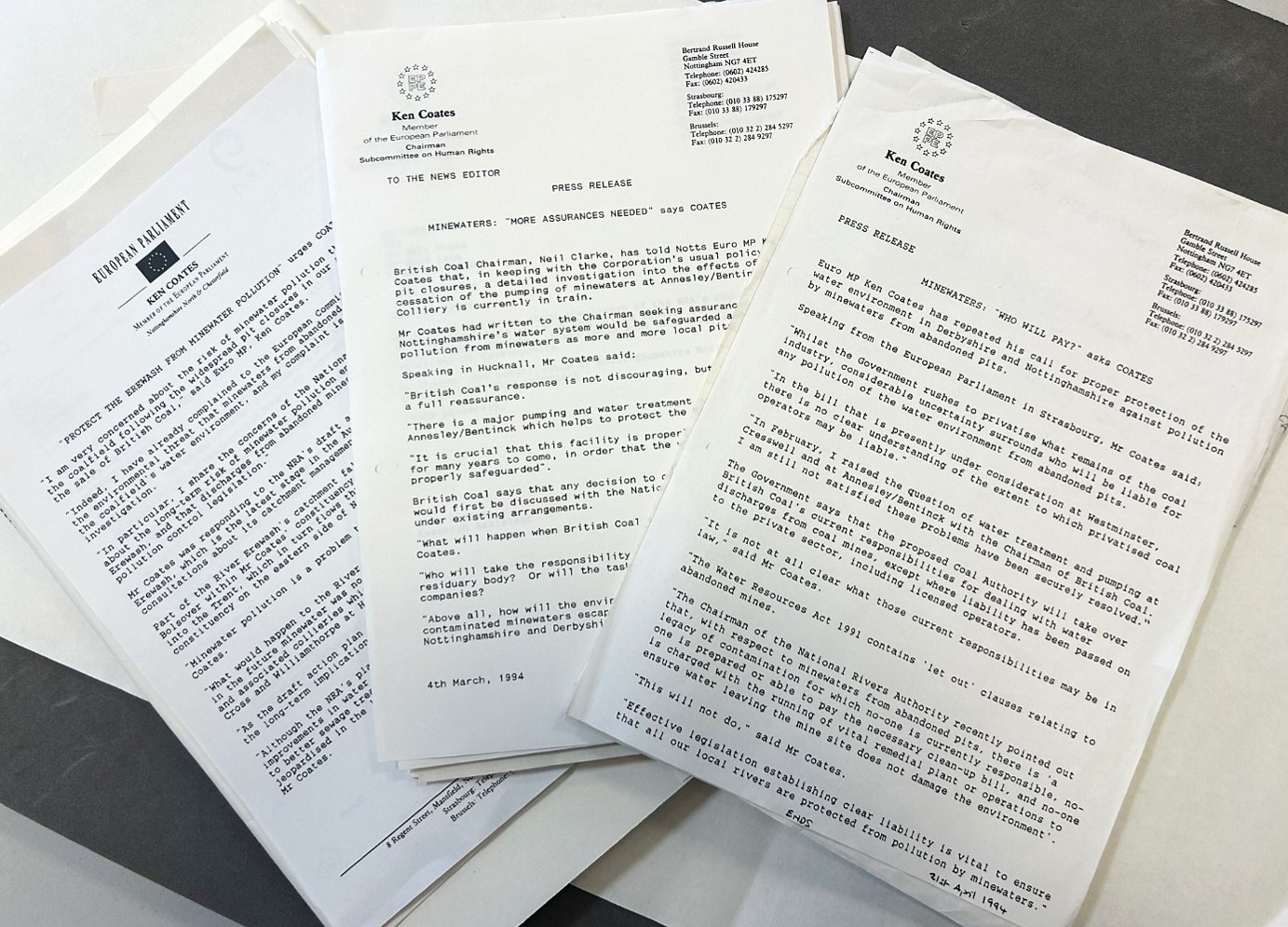
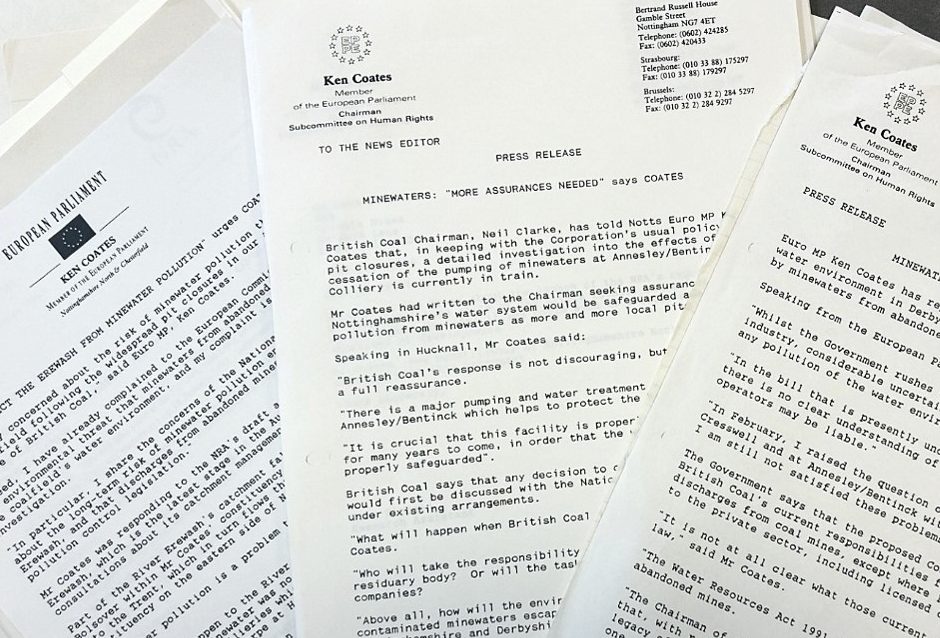
Press releases issued by Ken Coates about river pollution from minewaters, and his demands for the polluters to take responsibility.
When working through the files, the severity and sheer number of environmental issues in Coates’ constituency became clear. Affected areas included Staveley, Killamarsh, Whitwell, Wingerworth, Bolsover, Glapwell, Clay Cross, Worksop, Morton, and even more. These towns surround Chesterfield, extending north towards Sheffield and south towards Nottingham. Issues weren’t purely land-based either, with frequent mentions of the Doe Lea and Rother rivers. Coates was extremely passionate about organisations taking responsibility for pollution, and there were many press releases with mention of the ‘the polluter must pay’ principle. This was typically directed towards British Coal. During the 1990s, British Coal was in the process of being privatised, with the coal industry in steep decline. This led to lots of abandoned mines, and poorly managed industries associated with coalmining. Accompanying this decline was a growing public awareness of the harm in long-term environmental damage and risk to people’s health. Coates was in frequent contact with local environmental protest groups, rallying against the presence of dangerous industries in their area, such as the Killamarsh incinerator, or the Glapwell landfill site.
Coates was frequently involved in urging remedial management of sites that were contaminated with dioxins, which are highly toxic organic pollutants. A prime example of this was a 1993-1995 file on the National Rivers Authority (NRA), where Coates was corresponding with them over river and groundwater pollution in his constituency. At the time, the river Doe Lea in Derbyshire was the most contaminated river with dioxins in England. The source of the dioxins was effluent from Coalite, a company manufacturing petrochemicals. Additionally, British Coal and its successor, the Coal Authority, were criticised by Coates for their lack of environmental responsibility. He details how the Erewash and Trent rivers faced serious long-term risk from minewater pollution. This material also evidenced Coates’ position as an MEP, as he was in correspondence with the European Commission. Documents explained how UK legislation around abandoned mines didn’t align with European environmental law. There were many instances like this across the material I catalogued, where Coates leveraged his European ties to force the UK government to adhere to stronger environmental protections.
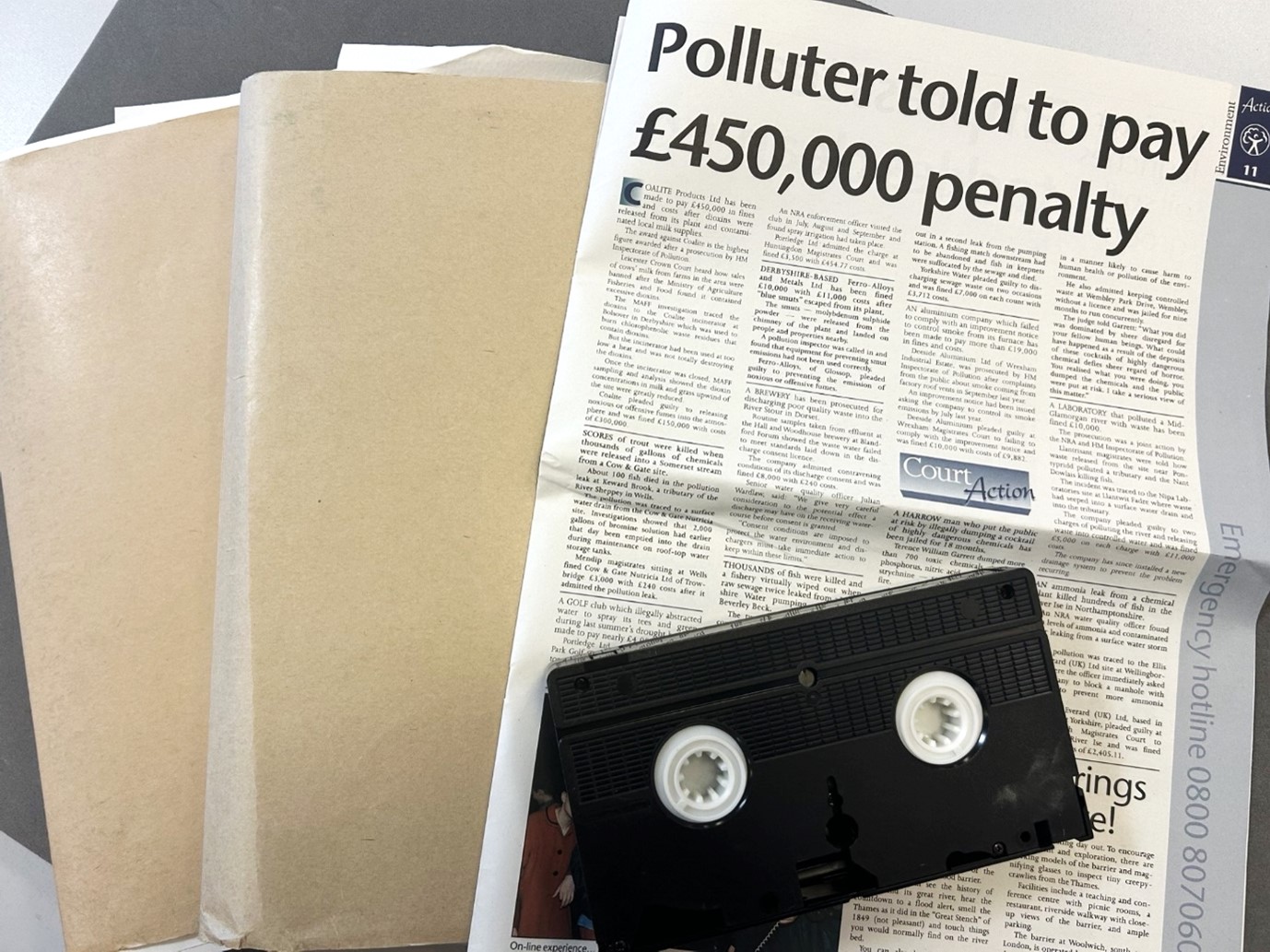
Newspaper and cassette: An example of the files I worked on. Many included environmental newspapers like this one, but the cassette was a much rarer find.
The Ken Coates collection remains a significant repository of Nottinghamshire and Derbyshire’s environmental past. Coates’ strengths of community engagement and multinational collaboration is a striking reminder of the power in collective governance. Environmental politics today in the UK and beyond could really benefit from the level of commitment Coates showed to his constituents, and the wider European sphere. This blog has only provided a snapshot of the work Coates was part of. The files I worked on really displayed his persistence, with many of his campaigns becoming successful years after the first discussions. Plenty of other files also highlighted his passion for local government, and his dedication to not only improving environmental health, but socio-economic conditions too.
I am grateful to my supervisor Sarah Colborne for her advice and guidance, and for the welcoming nature of the rest of the Manuscripts and Special Collections team.
Tony Simpson:
The EU Rivers Directive was enacted in UK law. When the Doe Lea was contaminated with dioxins, the European Environmental Commissioner advised what sections of the Directive were relevant. Ken Coates would then ask the UK Government what it was doing to come into compliance. As Claire says, this often took years to have effect, but ultimately the Coalfield environment improved somewhat.
Accessing the collection
The Ken Coates Archive and special collection can be accessed in the Manuscripts and Special Collections reading room at the University of Nottingham’s King’s Meadow Campus. Work is continuing on cataloguing the files relating to Coates’ work as an MEP. Claire’s placement is one of a series of placements working on Ken Coates papers and reflects our current focus on making historic records relating to climate and the environment more discoverable. More information on Coates’ role in the University’s Adult Education Department can be found on the webpage for the ‘Knowledge is Power‘ exhibition.
No comments yet, fill out a comment to be the first


Leave a Reply