
November 17, 2025, by Chloe
House of Many Names: Tracing the Evolution of Paton House
Paton House, a late-Victorian brick building featuring a large canopy over the opening, a conservatory adjoining the library and a Baroque interior, was designed in 1881 by Robert Evans and William Jolley, both of whom were Nottingham-based architects who had been trained by Thomas Chambers Hine.
The property, which went on to be built in 1884, was named West Hill House by its original owner, Samuel Herrick Sands JP. Like many of the early inhabitants of Highfields, Sands was a lace and hosiery manufacturer, but his industrial interests stretched across several industries, including banking, brick making, railways and even a telephone company! During this early period, cottage-style lodge on the Derby Road side of the house was likely inhabited by Sands’ coachman.
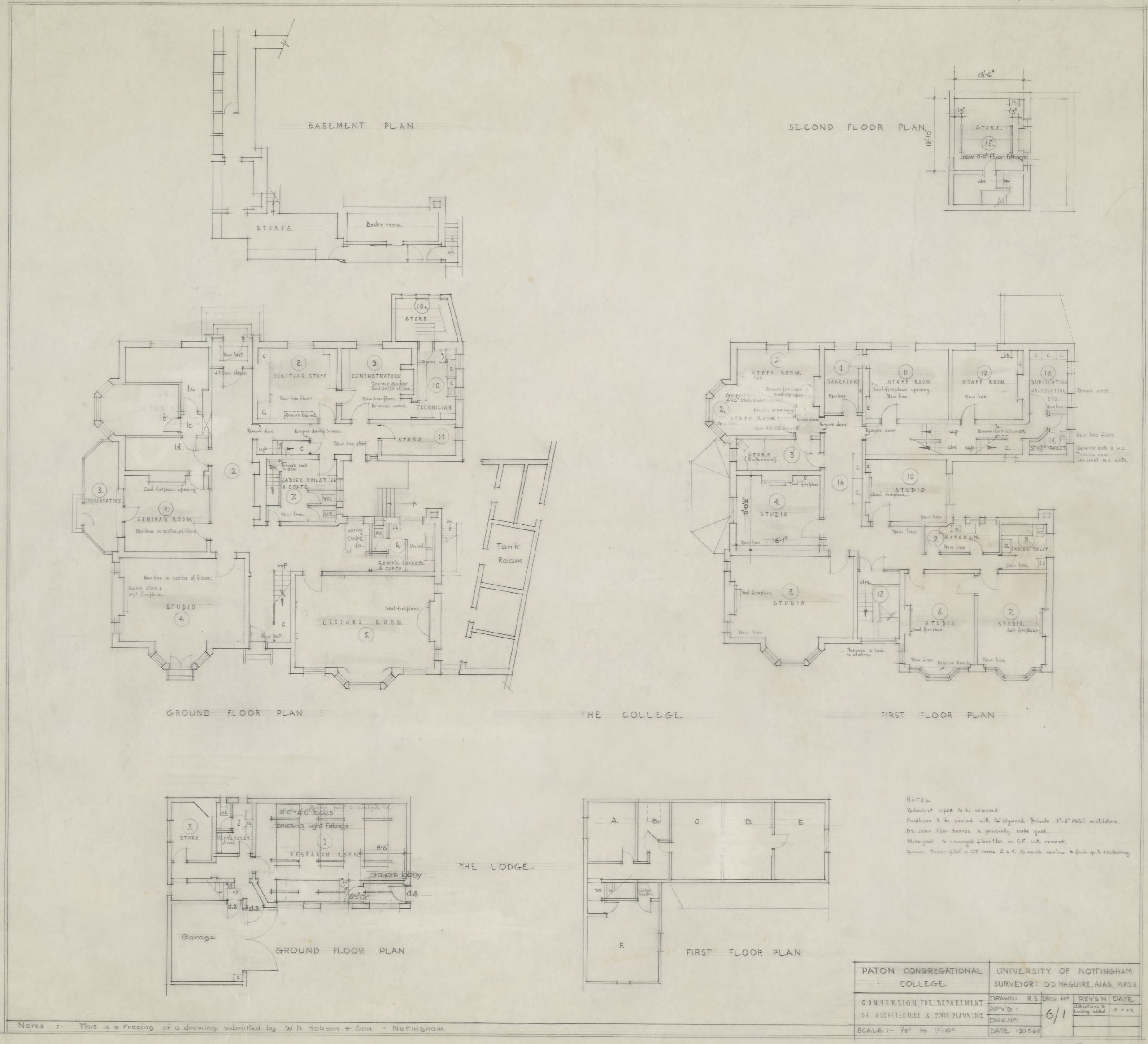
UFE/2/1/6/3 plans of Paton Congregational College, by O.D. Maguire; 20 May 1968
He occupied the property for just over ten years, selling it to Herbert Durant Snook in 1905. By the time Snook purchased West Hill House, which he renamed The Cedars, he was the director of Snook and Company, a clothing firm on Hounds Gate in Nottingham, but in a former life he had played football for Notts County! Snook didn’t make any major changes to the property over his 42 years of occupation, though, as carriages gave way to cars, the adjoining lodge became home to his chauffeurs. He passed away in 1947, and his widow put The Cedars up for sale the following year.
The University initially hoped to purchase the building, but was unable to secure the necessary funding, so it was sold instead to Paton Congregational College, a theological college which had been established in Nottingham in 1866. Until 1946, they had been based at Tollerton Hall, and when seeking new premises, they had prioritised proximity to the University College, hoping to deepen the relationship between the two institutions. At this point the house was bestowed with its third name, Paton House, to honour JB Paton, the congregationalist minister who founded the college.
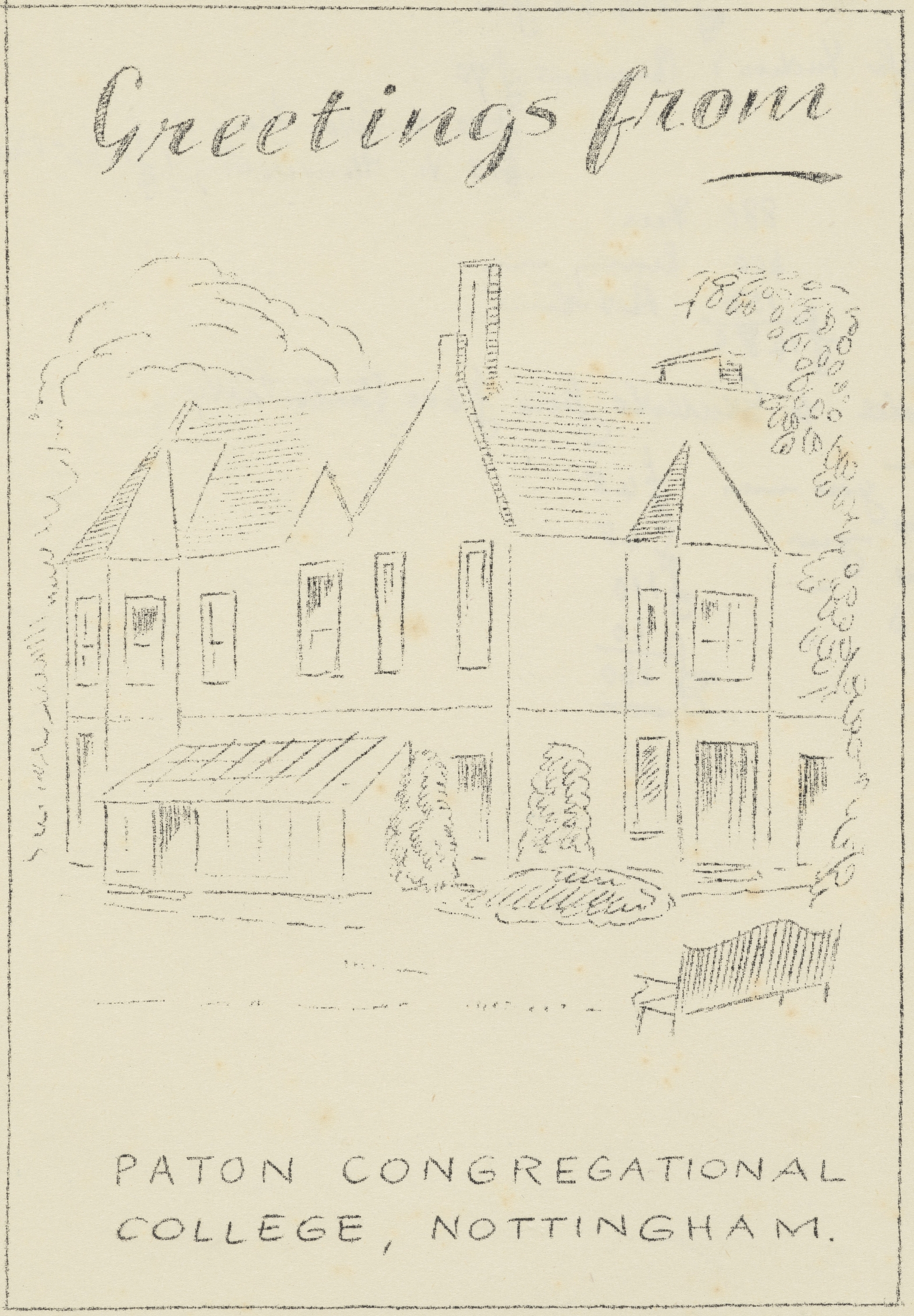
Fy X 2/2/20 Booklet titled ‘Greetings from Paton Congregational College, Nottingham’; 1957
When the college moved to Manchester in 1968, the University finally fulfilled its long-held ambition of purchasing the property, which was converted into a new home for the Department of Architecture and Civil Planning (now called the Department of Architecture and Built Environment). It has remained in use for the same purpose ever since, and has even retained its former name, Paton House, in commemoration of the previous occupants’ long association with the University.
If you’re interested in seeing the items featured in this blog for yourself, why not visit our reading room? To book your appointment, please contact us at mss-library@nottingham.ac.uk.
No comments yet, fill out a comment to be the first


Leave a Reply