
November 3, 2025, by Chloe
Luddites: Gangs of Loughborough?
Not a fan of AI? People might describe you as a ‘Luddite’, a term which is widely used today to describe people who are resistant to new technologies, but which actually has its roots in the early 19th century, as textile workers took action against mill owners who had acquired machines which threatened their status as skilled workers.
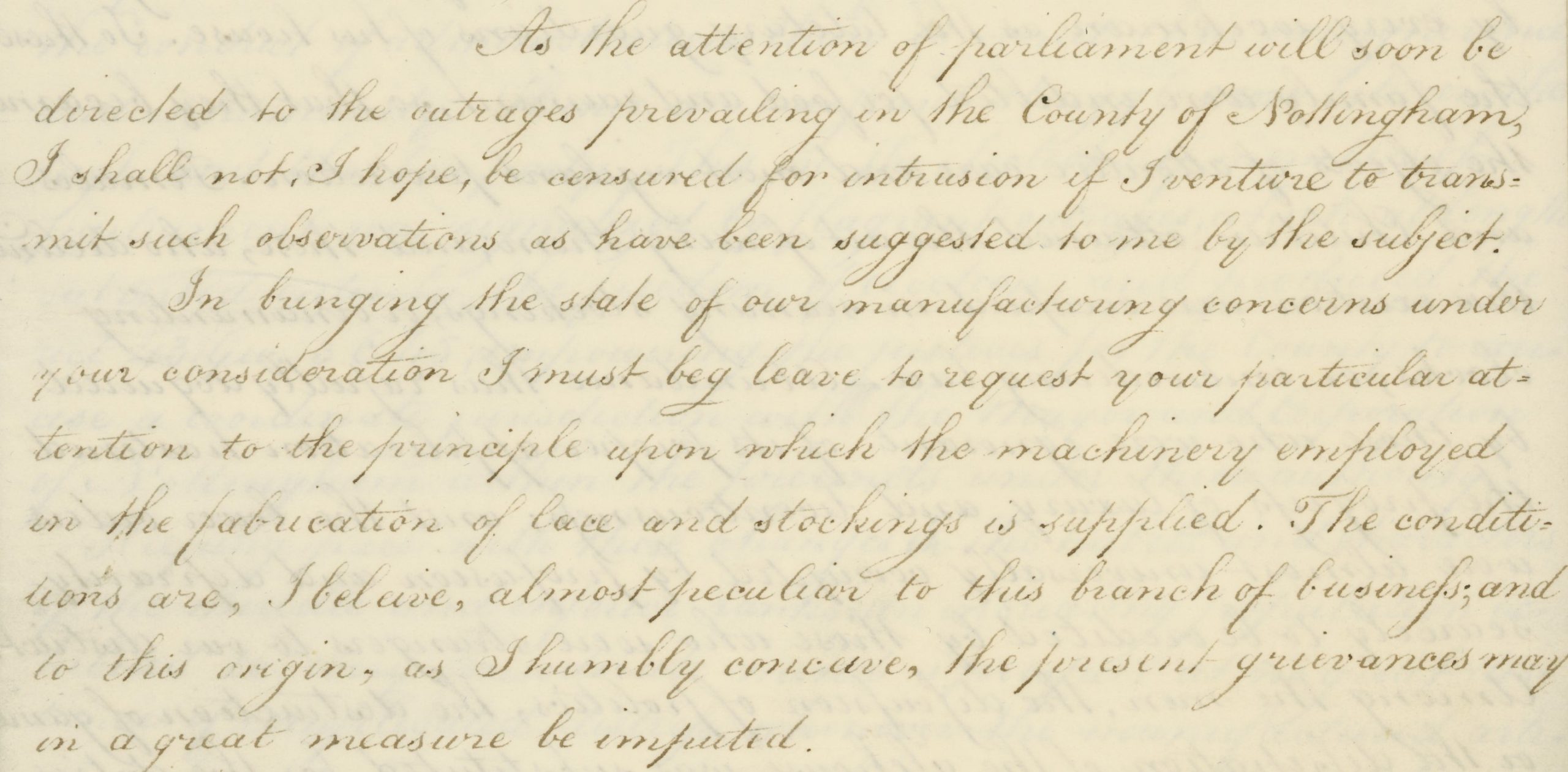
Ne C 4919/1, excerpt from the first page of a letter from Rev. John T. Becher to the Rt. Hon. Richard Ryder, Home Secretary; 12 Feb. 1812
Although the movement eventually spread across much of the Midlands and North of England, the spark had been ignited in Nottingham in 1811, and the city and its surrounding area continued to be hub of Luddite activity for much of the rest of the decade, fuelled by the concentration of textile workers in the region. The unusual name of the movement is derived from its legendary leader, Ned Ludd, a fictional weaver who had allegedly inaugurated the practice of smashing knitting machines in a fit of passion. Beyond the realm of fiction, it seems likely that the movement came about in response to economic hardship – fuelled by the strain imposed by the then-ongoing Napoleonic Wars – as argued in this letter by Nottinghamshire magistrate Reverend John T. Becher, who expressed some degree of sympathy with the rioting workers.
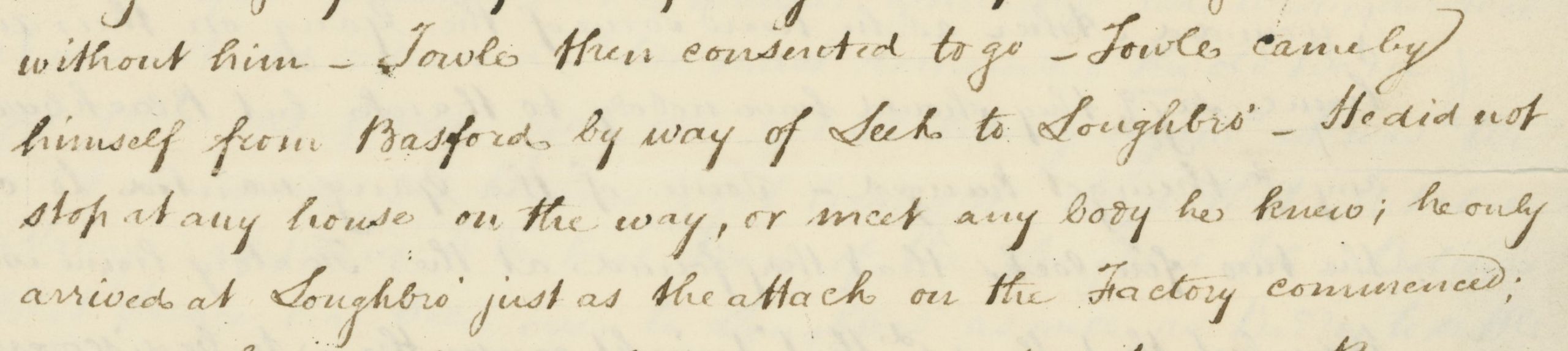
Excerpt from the first page of a statement made by James Towle on the morning of his execution, regarding his involvement in ‘the Loughborough Job’; 20 Nov. 1816
Perhaps the most famous local Luddite incident occurred at Loughborough on 28th June 1816, when a group of men, led by one James Towle of Basford, broke into Heathcoat and Boden’s lace mill and holding the guards and workmen within hostage at gunpoint while they destroyed 55 knitting frames and then made off with some lace fabric. During the raid, one of the guards, John Asher, was shot and wounded.
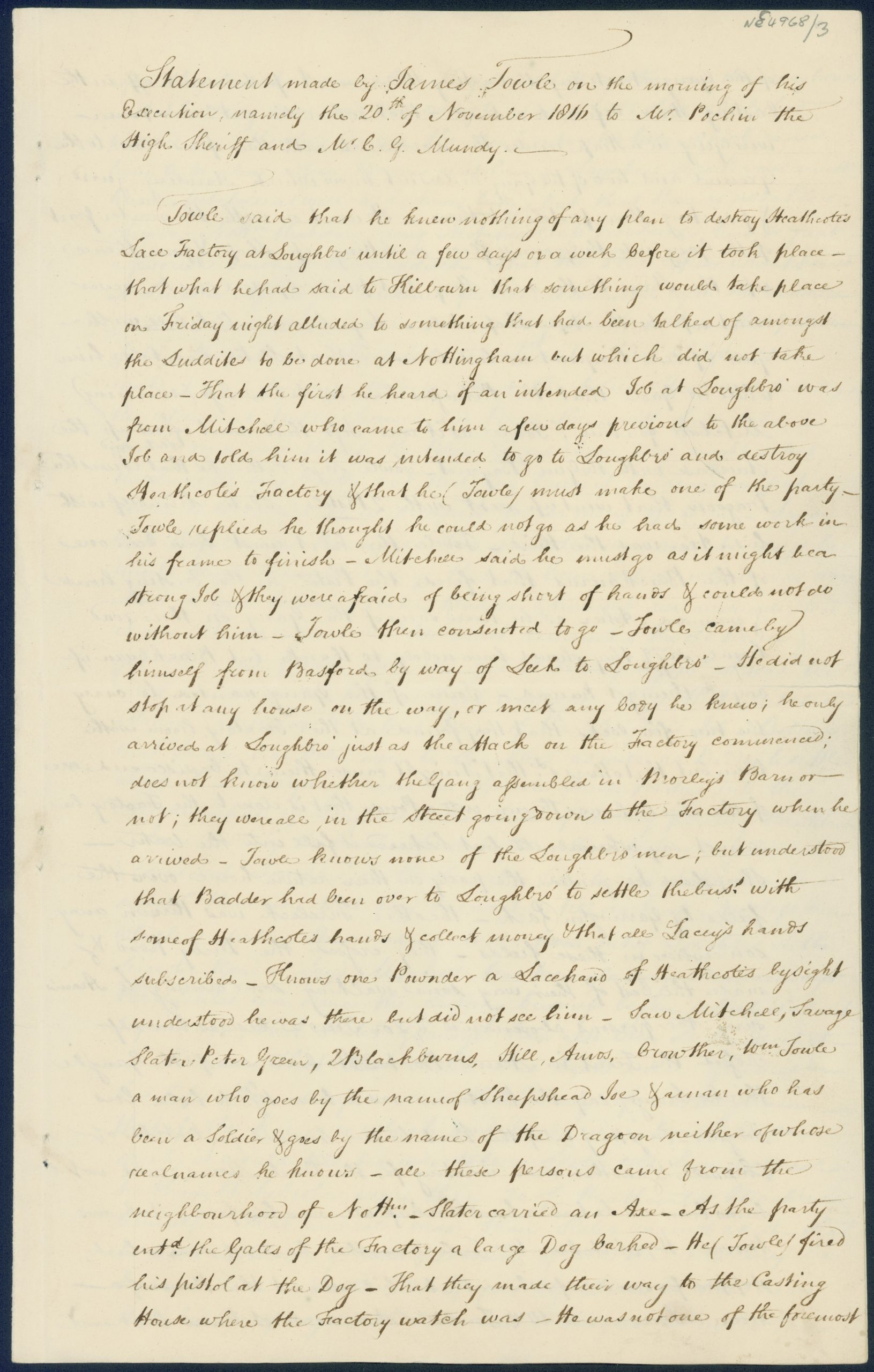
Excerpt from the first page of a statement made by James Towle on the morning of his execution, listing the names of others involved in ‘the Loughborough Job’; 20 Nov. 1816
Despite the attack’s initial apparent success, Towle had been recognised, and was apprehended several days later. He was tried at the Leicester Assizes alongside an alleged accomplice, John Slater, in early August. The trial did establish that he had not shot Asher, but he was nonetheless convicted; Slater was acquitted, although Towle continued to insist he had been involved.
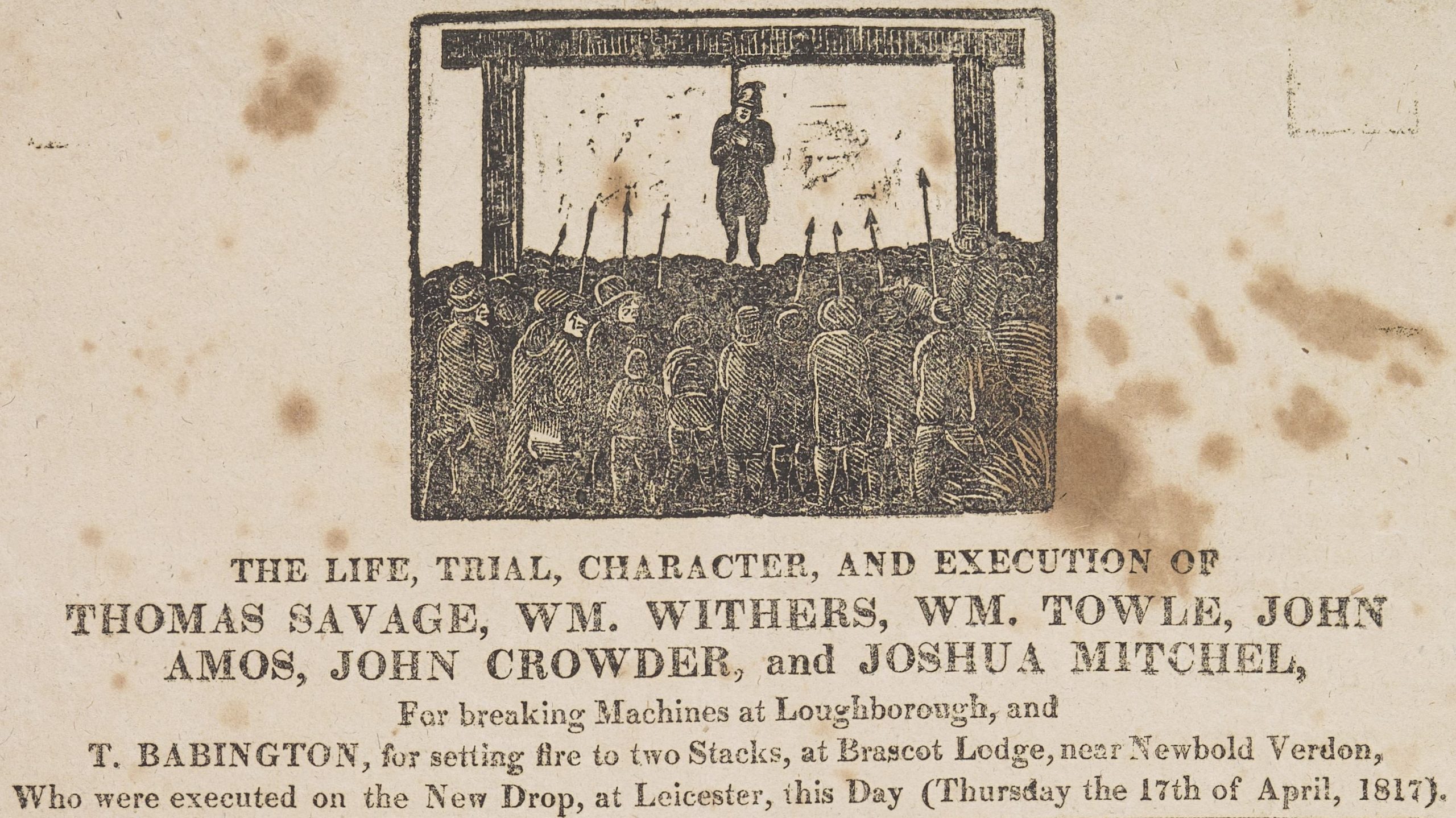
Illustration from ‘Life, trial, character and execution of Thos. Savage, Wm. Withers, Wm Towle, John Amos, John Crowder and Joshua Mitchel, for breaking machines, 1817’, No.40 from an album of broadsides relating to Nottinghamshire trials; 1759-1862. Over.X Not 1.H64 ALB.
Towle did appeal, but this attempt was unsuccessful, and he was publicly hanged at Leicester on 20 November 1816. A further six members of the gang were hanged the following year, and two others transported for life; all but Withers had been listed by Towle by name in the confession he gave on the morning of his execution. In fairness to Towle, his was hardly the evidence that cinched the case. As detailed in a broadsheet published on 17th April 1817 – the day of the second execution – two of the party who had participated in the attack (John Blackburn and William Burton) turned informant on the others, presumably in exchange for their own immunity.
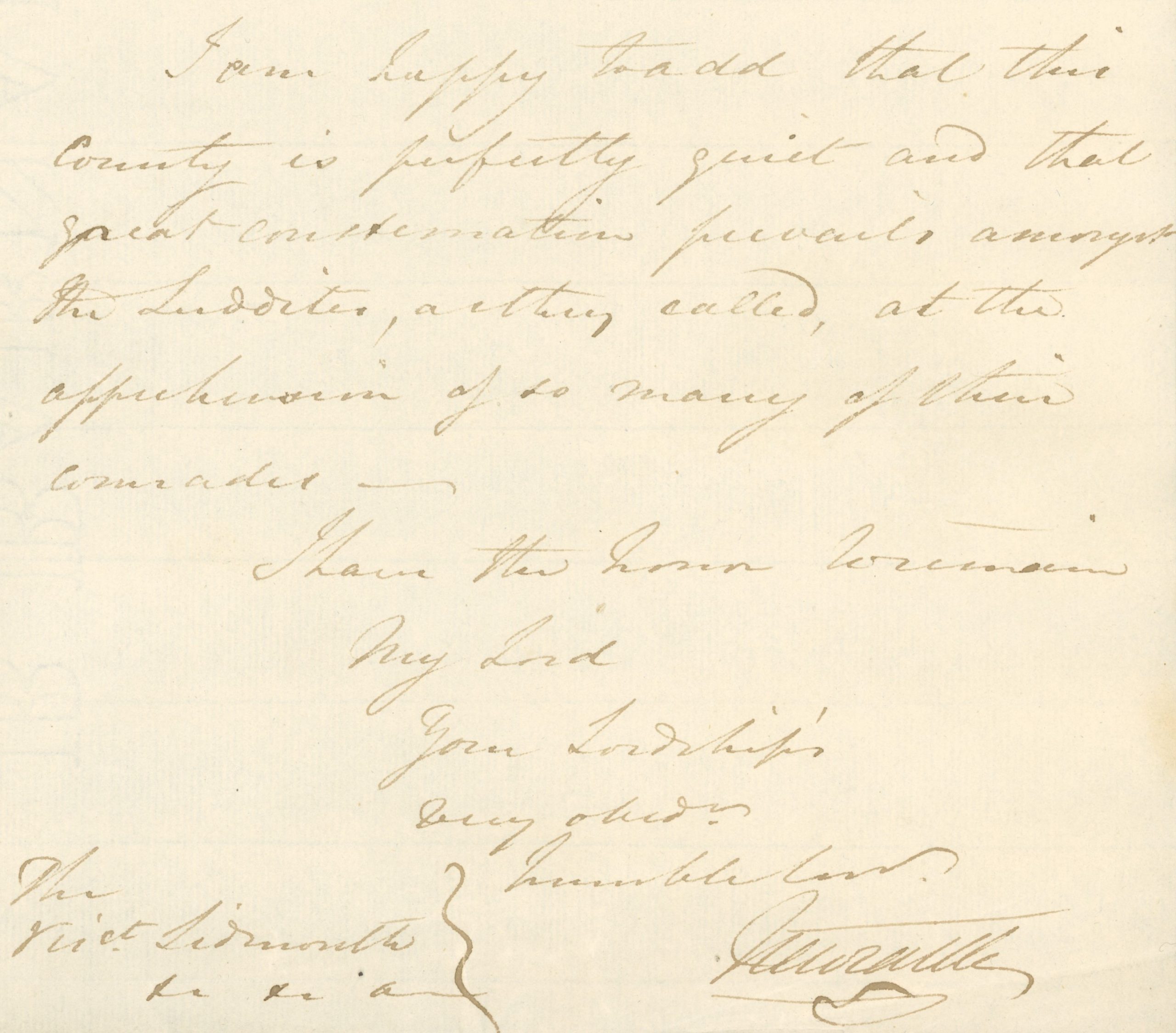
Ne C 4929 Excerpt from the final page of a letter from Henry, 4th Duke of Newcastle under Lyne, Clumber, Nottinghamshire, to Lord Sidmouth [Home Secretary]; 27 Feb. 1817
If you’re interested in finding out more, why not come and view the original documents mentioned in this blog in the Manuscripts and Special Collections reading room? Simply email mss-library@nottingham.ac.uk and we would be happy to book you in.
To learn more about the Luddites, why not check out our learning resource about Working Class Unrest?
No comments yet, fill out a comment to be the first


Leave a Reply