
October 14, 2025, by Helen Henshaw
Passing the microphone: How is amplifying the public-patient voice improving interventions and outcomes in adult hearing health research?
A blog by Natalie Lerigo-Smith and Nova Matthew, two PhD students with the Adult Hearing Health team.
The Adult Hearing Health team
Based at the NIHR Nottingham Biomedical Research Centre within Hearing Sciences at the University of Nottingham, our research focuses on patient and public priorities across four interconnected themes:
-
Hearing in dementia
-
Auditory training
-
Health behaviour
-
Care pathways
During Deaf Awareness Week (5-11 May, 2025) we welcomed 40 people to the University of Nottingham. Attendees were people who work with us and support our research. This showcase event celebrated our team’s progress and provided an opportunity for attendees to reflect on the teams future direction.

Captured: a soundbite of the day
The day began with a warm welcome. There were fresh pastries and an introduction from Dr. Helen Henshaw. Introduced were the team, its members, and recent achievements. Short research flash talks followed. Each highlighted one of the four themes and the current projects linked to them. These talks showcased some of the interventions developed by the team. For example, PLUS, which stands for “Practice Listening and Understanding Speech” is an auditory training program designed to address listening challenges through practice with listening games.
Feeding into this was a series of interactive demonstrations. Five stations were set up around the room. Designed to engage attendees with our past and present research. Four stations focused on interventions in development within each theme. Another showcased our past research publications.
After lunch, we held a Knowledge Café and passed the microphone to people with lived experience of hearing conditions. A knowledge café is a relaxed, informal meeting where people share ideas and learn from each other through open conversation. They shared their stories and how challenges can be better addressed. Our guest speakers included Alex Barker, Tom Dening, Jean Straus, and John Turner.
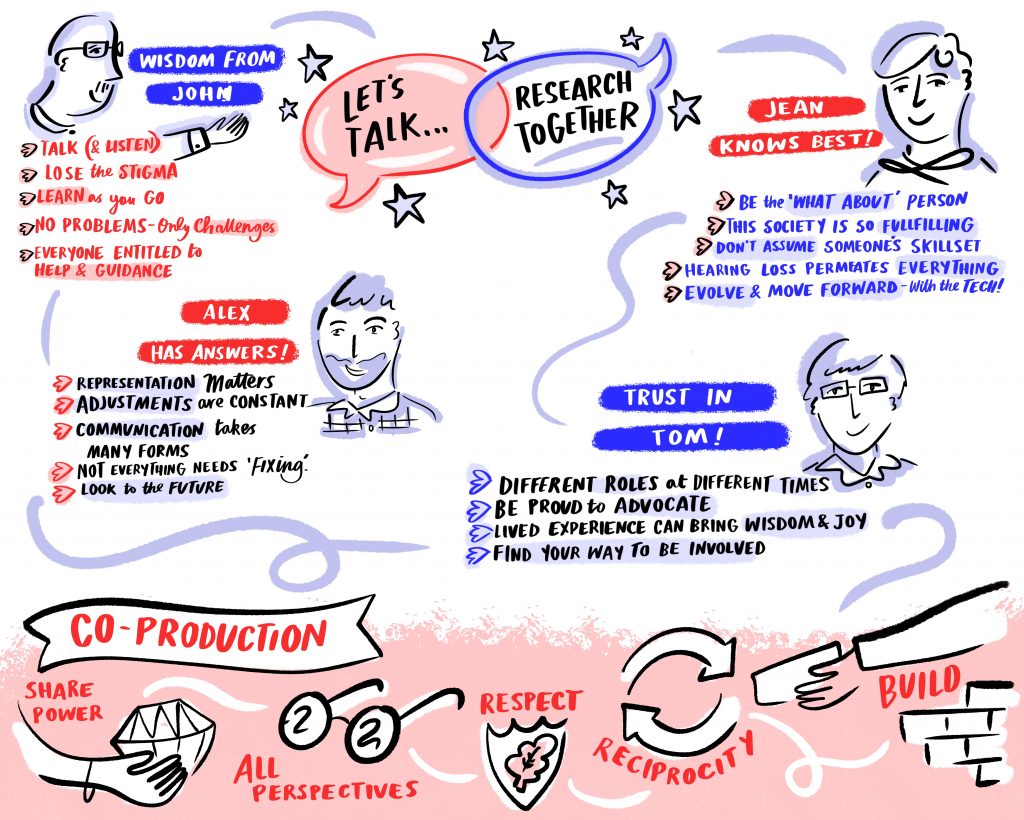
The day ended with a panel discussion with members of the Adult Hearing Health team. Followed by closing remarks from Helen. Attendees had the chance to ask questions to the team during the panel. Questions involved the team’s current research and future plans.
We offered our attendees several ways to share feedback with us during the showcase. This is key to our inclusive and accessible approach. For example, we placed postcards on the event tables for written feedback. Attendees placed the postcards into a box at the registration desk for our team to review later.
The larger soundscape: insights and key takeaways
We’re still early in our PhD programs and haven’t had many chances to connect with people who have lived experience of hearing loss. We found the Knowledge Café inspiring. Hearing the stories of people living with hearing loss was insightful. It reminded us how important it is for research to involve patients and the public. Rather than doing research for them. This message was present throughout these talks.
A key takeaway from the event was the importance of involving patients in research right from the beginning of the process; even before the development of research plans. It starts by understanding their needs and continues by working alongside them throughout. This ensures the research stays focused on what matters to those who will use the outputs of the research in their everyday lives.
Natalie’s PhD journey
The most common complaint for people with hearing loss is that they cannot hear speech in noise. Auditory training can help to improve everyday listening, even in noisy settings. While hearing aids are the most common intervention and help with quiet sounds, they make all sounds louder. This means people with hearing loss still find it hard to hear speech when there is background noise.
Everyday listening is challenging partly because people with hearing loss often miss the beginnings and ends of words. For example, if someone cannot hear the difference between /ba/ and /da/, it is hard to tell the difference between “bad” and “dad.” For this reason, PLUS includes a phoneme task that focuses on improving recognition of these speech sounds.
PLUS also includes a sentence task with competing speech, generated by people with hearing loss. The task reflects a real-life listening challenge they wanted to improve and helped make sure their priorities were part of PLUS auditory training.
My PhD work focuses on maximising improvements in everyday listening from PLUS auditory training. I will explore the speech and thinking processes that help these improvements happen.
At our showcase event, attendees tried out both PLUS tasks and we asked for feedback. We wanted to know whether the instructions were clear and how they could improve. In my PhD, I plan work with people with hearing loss to keep improving the PLUS program.
My work supports the Adult Hearing Health team’s goals and continues the commitment of the team to find new solutions to old problems, and to carry out inclusive and accessible research guided by public-patient involvement.
Nova’s PhD journey

Dementia and hearing loss often co-occur, significantly affecting communication, cognition, and well-being. The Lancet Standing Commission on Dementia Prevention, Intervention and Care (2027, 2020, 2024) https://www.thelancet.com/commissions-do/dementia-prevention-intervention-and-care. identified hearing loss as a potentially modifiable risk factor for dementia. The co-morbidity presents challenges distinct from each condition alone, yet guidance on recommended interventions is limited.
With an increase in research trials and further trials planned, there is uncertainty regarding which outcomes are important to measure when evaluating interventions for those with lived experience of both conditions.
My PhD project aims to develop a Core Outcome Set (COS) for studies evaluating interventions for co-existing dementia and hearing loss. A COS ensures that future research focuses on outcomes that are relevant, reducing research waste, as intervention trial results can be consistently reported and compared to identify effective interventions.
This project is aligned with the wider goals of the Adult Hearing Health team. Team members help me to access a wealth of expertise across both dementia and hearing health. The team’s broad knowledge base, spans over prevention, diagnosis, intervention, and care pathways. This helps me shape my project, while receiving opportunities for collaboration and knowledge exchange.
A key aspect of my project is stakeholder involvement. Developing the COS will involve direct input from people with lived experience of dementia and hearing loss, carers, clinicians, and researchers. This aligns closely with the DHL team’s commitment to meaningful involvement. Rather than creating a tool for the population, this COS will be developed with them, ensuring it reflects real-world needs and priorities.
No comments yet, fill out a comment to be the first

Leave a Reply