

Teaching at Nottingham
View this author's profilePosts by Teaching at Nottingham
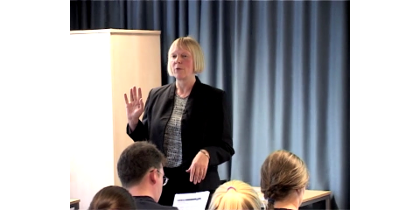
Beginning a session with an exercise
July 9, 2004
Video >> Do Coyle: “OK. Could you, first of all, look inside your pack and find the vocabulary list. “Now as future language teachers you’re all going to be dealing with vocabulary. So what I’d like you to do first of all is to take the vocabulary list, I’m going to give you 3 minutes …
Managing small groups in large groups
Video >> Lecture room There is the sound of conversations in the room as students work in small groups. Interview Do Coyle: “I was giving a session with over 300 students in one of the tiered lecture theatres; it was a one hour session. I knew that there was going to be follow-up in smaller …
Using aims at the beginning of a session to aid learning
Video >> Do Coyle: “I think it’s really important that at the beginning of any session, with any learners, that there’s clarification around where we’re going in a particular session. “I would expect them to do that with, say, pupils in school. I would expect the most erudite of professors to do that with their …
Monitoring small groups in large groups
Video >> Group working session There is the sound of many conversations in the room as students work in small groups. Interview Do Coyle: “There may well be instances where you want to monitor what the students are discussing, but the presence of the teacher or tutor in a group affects what people are going …
Demonstrations and visual aids in lectures
Video >> Liz Sockett: “I use props a lot in lectures, probably the least today actually, but it’s very important to have something that isn’t just PowerPoint. Not just because it’s monotonous having a lot of PowerPoint – you can hear people starting to get restless because you’ve done a lot of PowerPoint. “You also …
Asking questions of students in lectures
Video >> Liz Sockett: “Your average class, I would probably break it about 4 times with a straightforward question. In many of the subjects I teach it is easier to ask a question than in prions because I know that the chances of someone out here having had a relative with a prion disease is …
Explaining complex concepts
Video >> Liz Sockett: “One of the things that is very important when you lecture a subject like this is that you have drawn models that keep repeating. If you see the visual aids that I use, a lot of time was spent creating some simple models that I kept coming back to. “Although it …
Real life examples give context to learning in the lecture
June 9, 2004
Video >> Liz Sockett: “A lot of the diseases earlier in the course, bacterial diseases, we would stop and talk, for a couple of minutes, about. For example, ‘Who has had a sore throat?’ We actually monitor symptoms on the registers. So as the students are sitting in the lecture they are filling in a …
How “small” is a “small group”?
January 31, 2004
Michael Humphreys:”I don’t think there is a critical size for a small group. We have tutorials with 20 to 25 per tutorial but I don’t see that as a small group. “For me a group of between 4 and 10 is about right for small group teaching, depending on the nature of the task.” …
If lecturing is a performance, how do you prepare?
January 8, 2004
Video >> Christopher Barnatt: “A lot of people tend to think that you prepare a lecture by looking at the content and looking at the actual slides etc. When you think about a large group in particular, you have to think that there’s the content and there’s actually the delivery, or the performance of it. …
Find, follow, join us

