
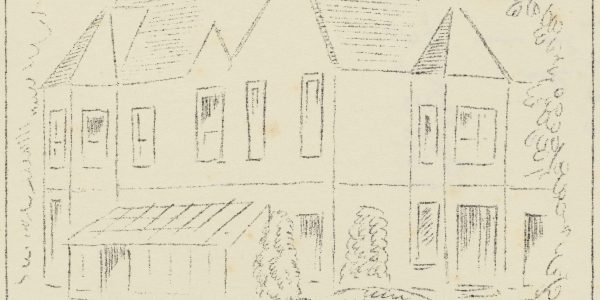
House of Many Names: Tracing the Evolution of Paton House
November 17, 2025
Paton House, a late-Victorian brick building featuring a large canopy over the opening, a conservatory adjoining the library and a Baroque interior, was designed in 1881 by Robert Evans and William Jolley, both of whom were Nottingham-based architects who had been trained by Thomas Chambers Hine. The property, which went on to be built in …
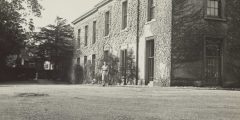
Botanists and Businessmen: meet the residents of Highfield House
August 21, 2025
Although it is today part of the university campus, when Highfield House was built at the end of the 18th century it would have been surrounded by pasture, and home to little more than a herd of cattle. Although the area would soon become well known as the site of luxurious homes for the wealthy businessmen …

Hugh Stewart Hall: from Marlepitt to Manor House
July 15, 2025
Today, Hugh Stewart Hall is concealed in a wooded hollow, accessible by a winding path leading through an iron pergola covered in climbing plants and past the old tennis courts to the garden, where the story of this remarkable property began. The east side of the garden was once a ‘marlepitt’, according to 16th century …

The Beginnings of University Park
May 22, 2025
Did you know that University Park was originally intended to be a ‘model village’ rather than a university? Prominent industrialist Sir Jesse Boot purchased the Highfields estate in 1919, with the initial idea of transforming it into an attractive self-contained suburb to house Boots employees. However, around the same time, he had been engaging in …

Einstein a Go-Go: When Albert Gave a Lecture at University College Nottingham
January 9, 2025
In a teaching room within the Department of Physics and Astronomy at the University of Nottingham hangs a blackboard, protected by a perspex sheet. This blackboard contains theoretical equations written on it by legendary physicist Albert Einstein during a lecture he gave at the University (then University College Nottingham) on 6 June 1930. Using archives, articles …
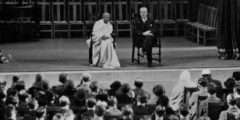
The day Mahatma Gandhi came to Beeston
July 15, 2024
On 17 October 1931 crowds gathered at the small railway station in Beeston, Nottinghamshire. It was a chilly afternoon, but that did not dampen the excited anticipation of the spectators. When they eventually saw him disembarking from the train, the watchers fell silent, curious. Clad in loincloth and sandals, with a shawl to protect him …
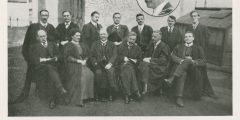
International Women’s Day: Dr Edith Becket
March 10, 2022
Dr Edith M Beckett (1877-1952) was one of the earliest students of University College, Nottingham, where she obtained a London BA degree in 1898. Unlike some universities, London (and thus by extension University College Nottingham, which did not award its own degrees) allowed female students to earn a degree, rather than simply complete their studies …
International Women’s Day: Alice Selby
March 8, 2022
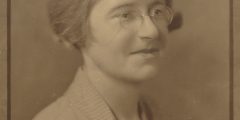
A creative, individual and superb teacher, Alice Selby was a force to be reckoned with when she joined University College Nottingham in 1918 after completing her studies at Cambridge University. She was one of only four academic staff in the English Department, and rising to become Senior Lecturer and Head of English. She taught …
You May Now Turn Over Your Papers
January 16, 2017
Term begins this week and many students will be plunged straight into exams. We’ve had a look through the University Archives to find out what the students of yesteryear faced when they turned over their papers. Music, 1939 Prior to 1948, University College Nottingham had no power to confer degrees. All qualifications (and therefore, examinations) were …
Happy Anniversary, Russian & Slavonic Studies!
May 19, 2016
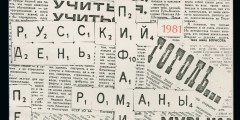
Did you know that Russian has been taught at Nottingham for 100 years? The academic year 1915/16 saw the very first students enrolled on Russian language courses at what was then University College Nottingham. It began with one member of staff on a temporary contract to try to encourage the study of Russian, and led to the founding of …
Find, follow, join us


