

Kathryn Summerwill
View this author's profilePosts by Kathryn Summerwill
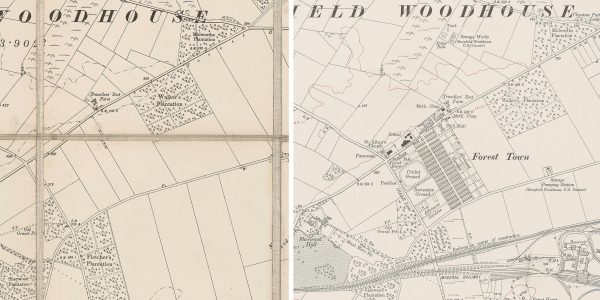
Forest Town: the town in the countryside
September 2, 2025
The coal mining boom of the late 19th and early 20th centuries had a lasting impact on the countryside. In 1920 over a million people were employed in coal mines across the United Kingdom, and many of them lived in purpose-built colliery villages like Forest Town. Housing in colliery villages Like many other aristocratic families, …

Thoresby’s Lady Rozelle: the Nottinghamshire landowner who loved the open ocean
July 8, 2025
Lady Rozelle Raynes, born Frederica Rozelle Ridgway Pierrepont, had a long life (1925-2015) of chance, tragedy, adventure and happiness. Her parents were Gervas Evelyn Pierrepont and Marie-Louise Roosevelt Butterfield. They were privileged but not titled. Gervas fought with distinction in the First World War and then became a London County Councillor. Marie-Louise’s father had inherited …
Handling History – a recent archive placement
April 23, 2024
This is a guest post by Jessica Reynolds, who volunteered at Manuscripts and Special Collections between February and March 2024, as part of the Faculty of Arts placement scheme. Working as a volunteer at the University of Nottingham’s Manuscripts and Special Collections felt like working as a Detective! Whilst on the Arts Faculty Placement module, …
Cataloguing History: Time with the Manvers Collection
November 21, 2023
This is a guest post by Andy Judson, a student volunteer studying towards a PhD in History at University of Nottingham. He recently completed a 60-day placement funded by the Midlands4Cities Doctoral Training Partership and the Arts and Humanities Research Council (AHRC). The placement engaged him to work with part of the extensive Manvers Collection, …
Working with the Coventry Patmore Collection
August 15, 2023
This is a guest blog by School of English Placement student Louise Roberts, who in 2023 worked on cataloguing additional papers of Coventry Patmore (1823-1896) When learning about Victorian literature, there is no doubt that Coventry Patmore’s poem The Angel of the House will be mentioned as one of the most influential pieces of literature …
Fungi and friendship: Margaret Cavendish-Bentinck, 2nd Duchess of Portland
June 21, 2022
This is a guest post written by UoN MA English Literature student Eve Campbell. Deciphering and researching the letters of Margaret Cavendish-Bentinck, 2nd Duchess of Portland (1715-1785), has been an insightful and rewarding experience and has allowed me to learn about different roles at Manuscripts and Special Collections. My placement required me to read through …
Sir Peter Kent
May 3, 2022
What links pleistocene sites in Kenya and Tanzania with the Forties oil field and the Lincolnshire Trust For Nature Conservation? The answer is the varied career of West Bridgford-born exploration geologist Sir Peter Kent (1913-1986). Archaeological work Kent studied geology at University College, Nottingham. At the age of 21 he travelled to East Africa as …
Beyond the Mayflower: nonconformist churches
December 1, 2021
Our new exhibition ‘Beyond the Mayflower’ is now open at the Weston Gallery, Lakeside Arts. The exhibition goes beyond the story of the ‘Pilgrim Fathers’ to look at the nonconformist churches established by people with similar views who chose to remain in Nottinghamshire. As seen in a previous blog post, the archive of the Archdeaconry of …
Beyond the Mayflower: Catholics and recusants
November 5, 2021
Our new exhibition ‘Beyond the Mayflower’ is now open at the Weston Gallery, Lakeside Arts. A previous blog focused on the persecution of Protestant dissenters who wished to reform the Church of England. The church authorities were, however, even more suspicious of Roman Catholics. In 1593 practising Catholicism was made illegal. As plots in favour …
Beyond the Mayflower: Separatists and Puritans
October 6, 2021
Our new exhibition ‘Beyond the Mayflower’ is now open at the Weston Gallery, Lakeside Arts. Among the passengers on the sailing of the Mayflower in 1620 were a group of religious separatists who wished to worship in a different way to that allowed by the Church of England. In the early 17th century the Church …
Find, follow, join us


