
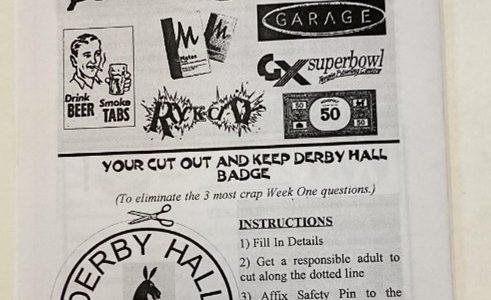
Extra mirrors and sewing rooms: “the civilising effect of female company upon the male population” in mixed halls of residence
September 5, 2024
Student placement Alice Lilley writes about her work on the Derby Hall archive at Manuscripts and Special Collections and what struck her about how student life has changed since the 1960s. As a volunteer through the Arts Work Placement module, I worked on the Derby Hall Collection for Manuscripts and Special Collections. This was an …

Photographing artefacts for the dear sisters exhibition
August 27, 2024
This blog post, written by Digitisation Assistant Catherine Martin, highlights the digitisation team’s role in preparing for a new exhibition. Before an exhibition is installed in the Weston Gallery, the digitisation team at Manuscripts and Special Collections photograph every item which has been selected for display, to create images which can be used in publicity, …
How to do a Scoping Survey at Manuscripts and Special Collections
August 16, 2024
This is a guest post by Hannah Kane, a University of Nottingham student, who recently completed a Summer Research Placement at Manuscripts and Special Collections. What is a Scoping Survey? A scoping survey involves identifying and checking material to establish its relevance to your research topic. In my case, another undergraduate student and I completed …
Feminist Footnotes
August 9, 2024
This is a guest post by Chiara Rebora, a University of Nottingham student, who recently completed a Summer Research Placement at Manuscripts and Special Collections. Expectations of my role? When I began this placement, I felt under-qualified and completely out of my comfort zone. I had to remind myself I was selected for this placement …
Gardens, Graveyards and Gladiators: A Victorian Journey through Italy
July 31, 2024
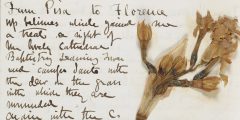
The sun’s out, school’s out – it’s holiday season once again! This summer, join 19th century tourists from the East Midlands as they travel through Europe and beyond in our series of blogs in the run up to Heritage Open Day, which this year will explore the theme ‘Routes – Networks – Connections’! In this …
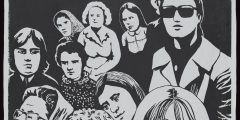
Art and activism: Rosemary Wels
July 22, 2024
Visitors to the exhibition dear sisters: activists archives at Lakeside Arts can’t fail to have noticed the striking designs of the posters produced by the Nottingham Women’s Liberation Group. We speak to the woman behind these posters, flyers and magazine covers to find out more about her art and her activism and ask how she …
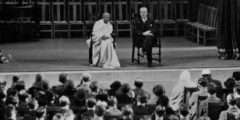
The day Mahatma Gandhi came to Beeston
July 15, 2024
On 17 October 1931 crowds gathered at the small railway station in Beeston, Nottinghamshire. It was a chilly afternoon, but that did not dampen the excited anticipation of the spectators. When they eventually saw him disembarking from the train, the watchers fell silent, curious. Clad in loincloth and sandals, with a shawl to protect him …

Page 3, pin-ups and double standards
July 10, 2024
Tina Pamplin of the Nottingham Feminist Archive Group, and Sarah Colborne, Archivist at the University of Nottingham, introduce a new addition to the East Midlands Feminist Archive: the ‘For Women Only’ calendar which was produced by Lincoln Women’s Action Group. They compare it to a similar occasion in the University’s history when printers refused to …
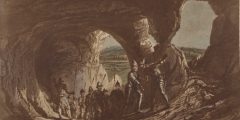
Dead End? Tunnels under Nottingham in fact and fiction
June 28, 2024
Considering the number of manmade caves which lie beneath the streets of Nottingham, it is unsurprising that, over the years, a tangled web of stories has developed which imagines a secret network of tunnels beneath the city. The details vary, with passages variously linking the city centre, the castle, and Wollaton Hall or running instead …

George Green Library: Then and Now
June 18, 2024
To commemorate 60 years since the opening of George Green Library, Tracey O’Sullivan, Library Advisor, shares her memories and photographs from working there since 1985. Imagine the scene: no computers, no mobile phones, no Wi-Fi, no laptops, no self-service machines, just lots of books, journals and the like; card index cabinets and photocopier machines that …
Find, follow, join us


