
August 12, 2025, by lzzre
Sneezing city: mapping allergenic tree pollen in Nottingham
D
Have you been sneezing a lot lately? If so, you aren’t alone! At least this is what Nottingham residents and visitors described in an online questionnaire distributed by a team of researchers from University of Nottingham. During early spring, we asked participants to share their experiences and emotions about this year’s allergies to tree pollen. For anyone who has prior experience with hay fever the following words may have come to mind more than once: “tired”, “ill”, “itchy”, “annoyed”, “exhausted”… and the list goes on and on, ranging from mildly unpleasant feelings to very negative ones (Figure 1).
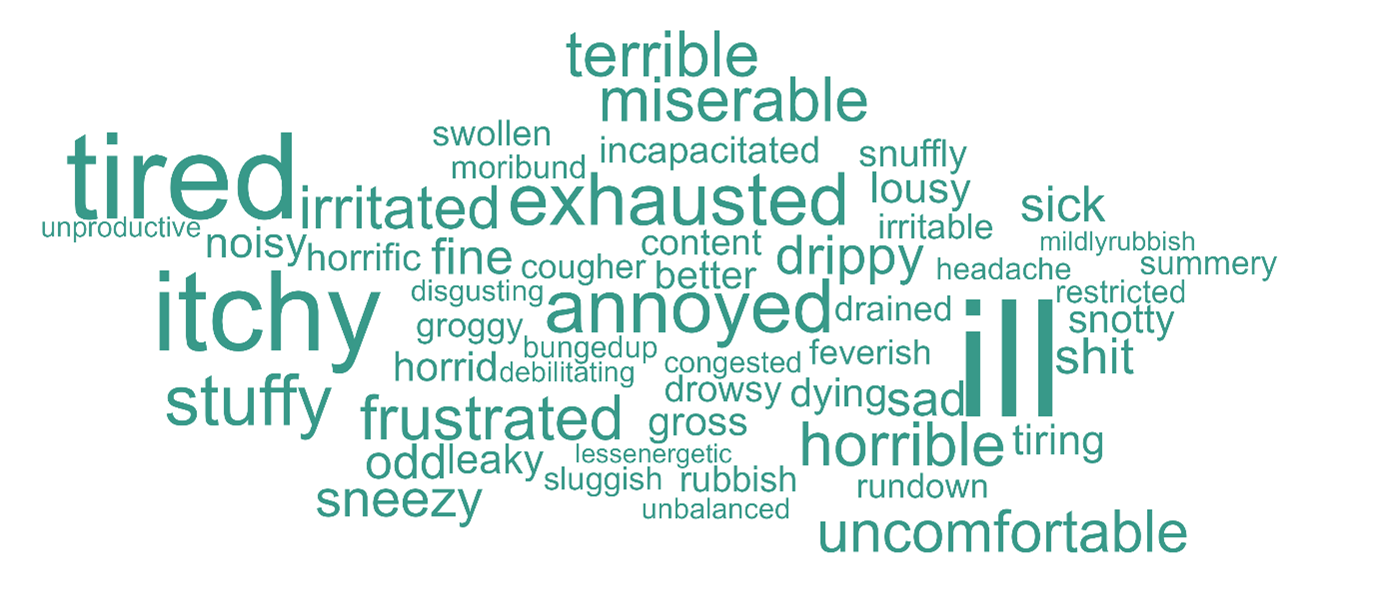
Figure 1: How does hay fever make you feel? We asked residents and visitors of Nottingham to express their feelings about this year’s hay fever caused by tree pollen using one word. Words in larger font collected the most answers, while those in smaller only appeared a few times in the responses.
Hay fever (Allergenic Rhinitis) is a common allergenic condition caused by a reaction to pollen and other dust like particles that are found in the atmosphere. According to academic literature more than 1 in 4 adults and nearly 1 every 6 children have experienced hay fever at least once in their lives. Recent studies have also shown that rising temperatures due to climate change will result in longer allergy seasons and stronger symptoms. For this reason, a team of researchers from the departments of Geography and Biosciences led by Dr. Michela Mariani decided to investigate the impact of hay fever in the Nottingham City Council (NCC) area. The full team includes Dr. Faidra Katsi, Alastair Wills and Prof. Simon Gosling. We presented our study to representatives of Nottinghamshire County Council and UK Health Security Agency at an event at the University of Nottingham’s City as Lab venue at Castle Meadows Campus on the 8th of July 2025.
We presented our main aims:
- to map allergenic tree pollen across the Nottingham City Council area
- to allow participants to share their thoughts and experiences about hay fever, and brainstorm the potential drivers and effects of mapped pollen distributions.
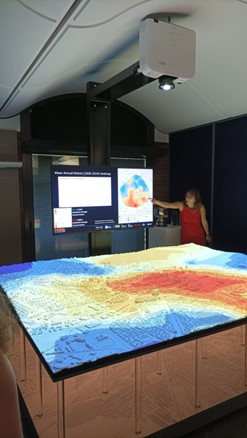
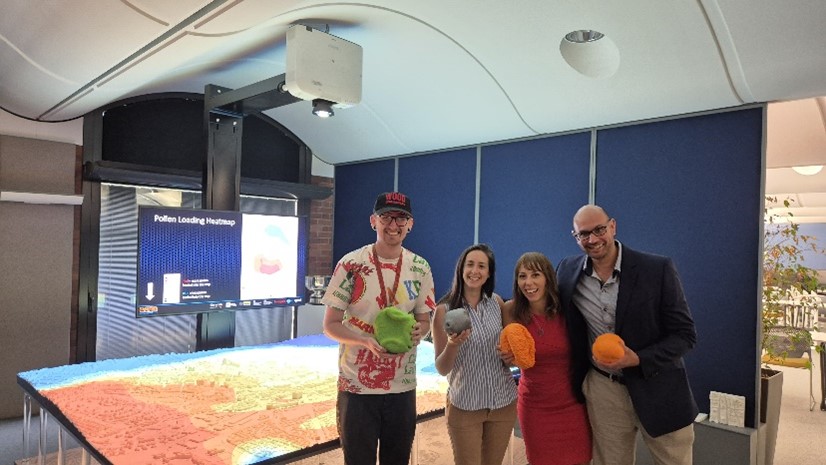
Those invited to the event had the opportunity to hear about how we collected our data and our main findings and also we gave them the opportunity to interact with our results using the University’s PARM (Projection Augmented Relief Model), which is a 3D printed model of Nottingham, developed and printed by Dr Gary Priestnall in the School of Geography, augmented from above with projected maps, images and animations (Figure 2). Our study was part of the “Telling Stories” theme around Nottingham and funded by the City as Lab initiative of University of Nottingham.
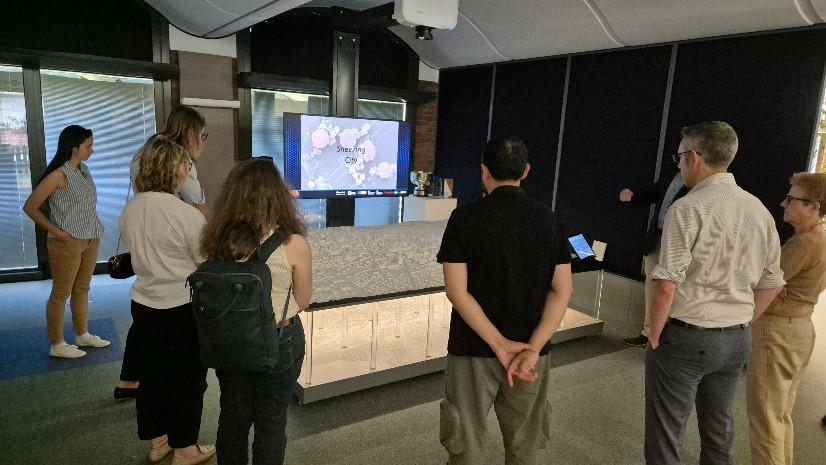
Figure 2: We presented our results on a 3D-printed model of the city of Nottingham at the University of Nottingham’s City as Lab.
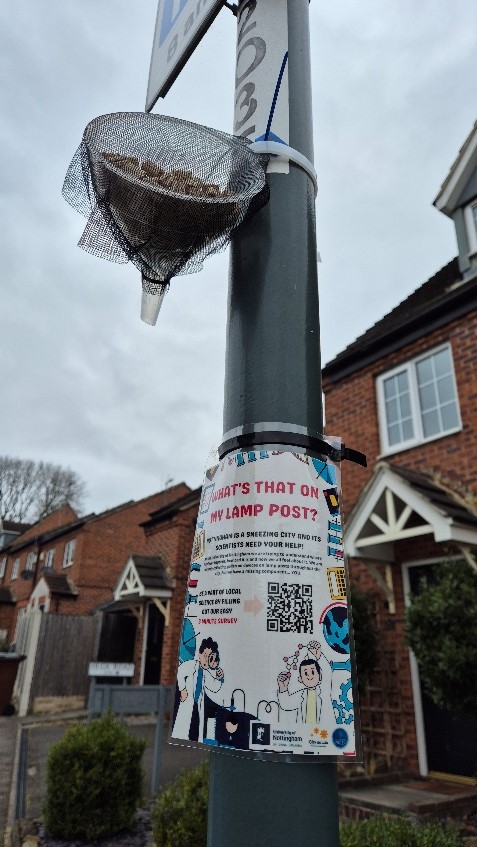
How did we get to this map? First, we needed to collect pollen from around the city using some special funnels (traps) installed on lamp posts across the city (Figure 3). At the bottom of the lamp posts we attached a flyer with a link to our online questionnaire where participants could share their experiences about hay fever.
Our pollen traps consist of a funnel, filled with filter tips and covered with a mesh to keep everything in place. Once they are installed on the lamp post they start collecting tree pollen. Trees produce pollen, tiny particles of different shapes and sizes, to help them reproduce. The main period of tree pollen production is early spring. After trees produce pollen, air will transport those pollen grains and eventually some of them will fall into the funnels where they are “trapped” within the filters. We left those traps in place until early April to capture the pollen released by trees. We then separated the pollen from the filters.
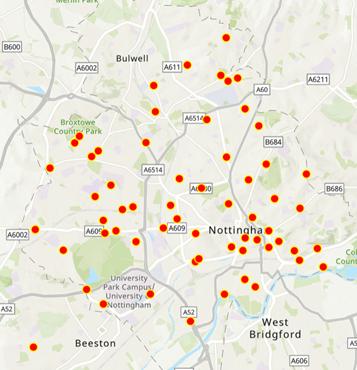
Figure 3: Have you seen our pollen traps (funnels that collect pollen) in your neighbourhood? An image of the lamp post on the left and on the right a map with red dots showing all the points where we installed the pollen traps.
Once we counted the pollen, we created a map of the areas with higher and lower pollen levels. Our preliminary results show that areas in the south show the highest pollen levels, while northern areas present lower pollen levels. We are currently exploring what could be causing such patterns, considering tree density, wind direction and the potential influence of pollution from vehicle traffic. We are aiming to unpack these findings more in the future so stay tuned!
Let’s take a closer look at our results from the surveys now. If we think of ourselves as “moving pollen traps” when breathing, we may start to understand why so many participants expressed unpleasant experiences about this year’s tree hay fever period. For 33% of the survey responders their hay fever symptoms were worse than normal. More than half of the participants described their symptoms (sneezing, runny and blocked nose, coughing, itchy, watery eyes among others) to last between several weeks to several months (Figure 4). The vast majority of the participants (77%) have used over the counter medication but only a third of them have visited their GP regarding their symptoms. As temperatures rise the pollen-release period becomes longer, so it is not surprising that 53% of the participants experienced hay fever often or very often.
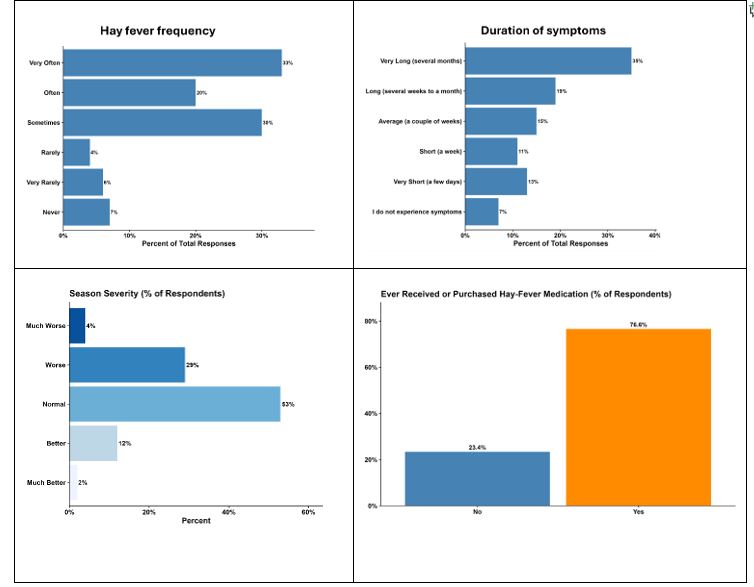
Figure 4: We asked survey participants to tell us how they have experienced hay fever this year (2025). Our respondents told us that 33% of them had worse than normal symptoms, 77% used medication to ease their symptoms, 53% of the participants experienced hay fever often or very often and 54% of them had hay fever symptoms lasting between several weeks to several months.
It is surprising how such a small particle like pollen can affect us. Pollen is well hidden in Nottingham, but with the right tools we can discover it, count it, explain it and share our ideas with all of you experiencing hay fever this year! We salute you with a tissue and we will be back with more scientific findings in the future.
No comments yet, fill out a comment to be the first


Leave a Reply