
September 1, 2025, by Arts Placements
Researching Villains and Victims: Reflections on My Placement
2nd year History student, Daisy Wu, tells us about their experience on the Summer Research Placement Programme
This summer, I took on a research placement linked to the Villains or Victims? module. The research explored the complex role of white women in the British Empire and the women who worked for them. My work combined archival research, data analysis, and teaching-focused resources. While I gained new insights into empire and its lasting impact, what stands out most are the personal and professional benefits I took from this experience.
Working with the Archive
A central part of my placement was conducting archival research in Manuscripts and Special Collections. At first, this was a challenge, many of the sources I came across didn’t match the module’s time frame or focus. This highlighted how colonial archives privilege certain voices, usually administrators and elites, while silencing others. A breakthrough came when I uncovered the Hoyland files. These offered glimpses into the lives of women rarely represented in official records. Yet even here, gaps and silences were evident. This taught me to think critically about what is in the archive and what is missing, and why.
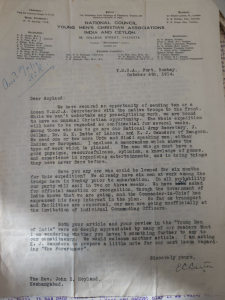
MS 733/1/6/3 – Hoyland Letters, newspapers, pamphlets, postcards, and other forms of communications
Developing New Teaching Materials
Alongside this, I also created a dossier for a new Childhood and Domestic Workers Week, focused on Hong Kong and India. This involved collating archival documents, photographs, and secondary scholarship into a clear, accessible format for teaching. In doing so, I strengthened my skills in evaluating sources, organising information, and highlighting connections across different types of evidence. I learned to balance detail with clarity so that complex material could be used effectively in lectures and seminars. Working with fragmented records – such as those on Ayahs and Amahs, South and East Asian women who worked as nannies for British families, also taught me how to interpret silences in the archive. Of the 19 photographs I identified, only four included names, reminding me that gaps and absences can be as revealing as the material itself.
Mapping Whose Voices Are Heard
Another strand of my placement involved data visualisation of the module’s reading list. I recorded each author’s geographical affiliation to see whose scholarship shaped the module. The findings were clear, 41.9% of authors were based in the UK, while most others came from Europe, North America, or Australia. Scholars from South Asia, Africa. and the Caribbean were barely represented. To highlight these disparities, I created a map and pie chart, which will help inform the future decolonisation of the module’s curriculum.
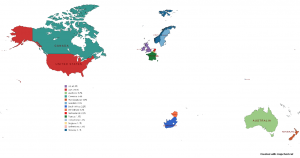
Map of the Geographical locations of the Reading List authors made using Mapchart.net
Personal and Professional Growth
Looking back, the real value of this placement lies in how it shaped me both personally and professionally. On a personal level, it was humbling to confront the silences of the archive and the stories of women whose lives were overlooked. It made me more aware of how history is constructed, and how power operates in what is remembered – and what is forgotten. This has changed the way I approach not just academic texts, but the past more broadly. Professionally, I developed a variety of skills that I know will help me in the future. The first being patience and persistence in archival research, the ability to transform data into clear, impactful visuals. And experience designing teaching materials that bring complex histories into focus. Finally, confidence in connecting academic research with broader debates about decolonisation
No comments yet, fill out a comment to be the first
Leave a Reply