
September 5, 2025, by Arts Placements
Mapping Medieval Music: Reflecting on my Research
2nd Year History student, Sebastian Marzanati tells us about his experience on the Summer Research Placement Programme
Introduction:
I was part of the Summer Research Placement Programme (SRPP), doing the Wollaton Antiphonal and Its World project. The Wollaton Antiphonal is a highly decorated musical book from the early 15th century, commissioned by a Nottinghamshire knight to use in his chapel. After the knight’s death, St. Leonard’s parish church in Wollaton owned and used the book. Medieval music books were used to instruct the performances of church services. They often contained musical notation to guide chanting or singing. The project explored the patterns of survival of medieval books. It focused on mapping musical parish books and analysing contextual data to uncover insights into the use of these books in parish churches of medieval Britain.
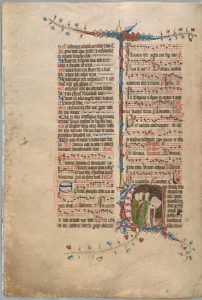
A page of the Wollaton Antiphonal manuscript, featuring musical notation and significant decorative elements.
Research:
During the first week, I read about how books were used in parish churches and how this changed over time. This felt like preparing essays. I met my supervisor weekly, I found these regular meetings to be very helpful for advice. The placement also allowed for creativity, by making a poster. The Poster Creation Workshop helped me feel more confident with designing a visually engaging poster. In the second week I used previous research to create a dataset, developing my Excel skills. I enjoyed exploring contextual data, such as geographic and economic data. The bulk of work began in the third week. I used ArcGIS software to create maps and graphs. Using geographical data, I linked surviving books to variables such as parish wealth or patronage. This was valuable for gaining skills in data visualisation and analysis.
I also attended the Careers in Research Workshop, gaining professional awareness of how academic and non-academic jobs involved research skills. In the last week, I continued developing my map and graph resources. Additionally, I advanced my statistical analysis skills through data normalisation and correlation analysis so I could communicate my results more effectively and confidently. The final work of my placement was poster creation. I enjoyed designing a poster that incorporated the medieval aspect of the project and used my own map to visually communicate my results.
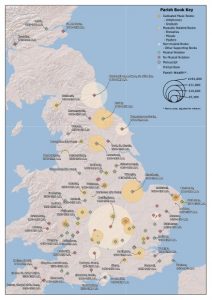
Surviving medieval books across Great Britain, coloured by their use in performing church services.
Results and Reflections:
I mapped and analysed medieval parish books to gain insight into their use and survival, focusing on musically notated books. Dedicated music books appeared to be owned by less wealthy parish churches, having a median wealth 30% less than that of all recorded churches. St. Leonard’s parish ownership of the Wollaton Antiphonal is less surprising given this insight, possessing 39% less wealth than the overall median. I found that each potential insight raised questions about how I could have collected more data or used it differently.
I was excited to start the project and get research experience in my favourite period of history, as I was already thinking about entering postgraduate research. What I did not expect was how much I personally enjoyed the creativity involved in making the maps and the poster. I am considering more non-academic areas of research now, which was helped by the Careers in Research Workshop. The placement also really developed my data visualisation and analysis skills, as I enjoyed the problem-solving. The interdisciplinary qualities of the placement made it a personally fun, and challenging, experience. I would highly recommend it to anyone considering research or wanting to gain interdisciplinary skills and competencies.
No comments yet, fill out a comment to be the first
Leave a Reply