
Handling History – a recent archive placement
April 23, 2024
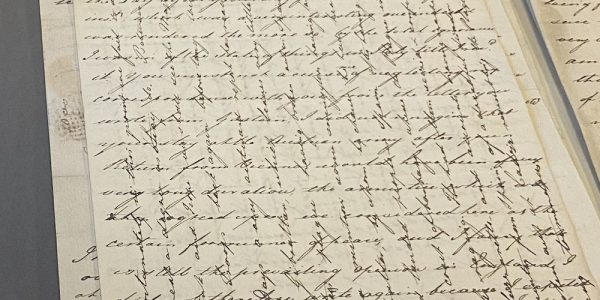
This is a guest post by Jessica Reynolds, who volunteered at Manuscripts and Special Collections between February and March 2024, as part of the Faculty of Arts placement scheme. Working as a volunteer at the University of Nottingham’s Manuscripts and Special Collections felt like working as a Detective! Whilst on the Arts Faculty Placement module, …
dear sisters exhibition opens
April 10, 2024
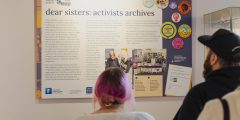
Manuscripts and Special Collections were delighted to welcome so many people to the launch of the exhibition dear sisters: activists’ archives at the Weston Gallery last month. The exhibition was officially opened by Professor Shearer West, the University of Nottingham’s first female Vice-Chancellor, and Vandna Gohil, CEO of Nottingham’s Women’s Centre. Both spoke of the importance …

Discovering Iceland with the Benedikz Collection
April 9, 2024
The University of Nottingham may seem like an unlikely home for a treasure trove of Icelandic literature, but, nonetheless, in 1998 we welcomed the Benedikz collection: an assemblage of Old Icelandic sagas, poetry and travel books which greatly enhanced our pre-existing holdings of Norse, Icelandic and Viking literature. So, how did this remarkable acquisition come …

A Peek Behind the Iron Curtain
March 19, 2024
This is a guest post by Samantha Brinded, a volunteer at Manuscripts and Special Collections. Several months ago, upon expressing my interest in volunteering for the archives, I received an email inviting me to contribute to a project involving the School of Geography. The task would involve collating metadata for hundreds of slides, and subsequently …

The Nottingham Feminist Archive Group: activist archiving
March 6, 2024
To mark International Women’s Day, find out how the Nottingham Feminist Archive Group have been collaborating with Manuscripts and Special Collections at the University of Nottingham in this guest blog by Group member, Jayne Muir. The upcoming exhibition dear sisters: activists’ archives at Nottingham Lakeside Arts (21st March – 1st September 2024) showcases material from …

Audrey Beecham: Warden, historian, poet, anarchist, feminist, and champion of the underdog
March 1, 2024
Helen Audrey Beecham (1915-1989) came to the University of Nottingham in 1950 having been appointed warden of the newly built Nightingale Hall, which at the time was a women-only hall of residence. She served as warden and also lecturer in social and economic history for 30 years until her retirement in 1980. Before coming …
Victorian Valentines
February 14, 2024
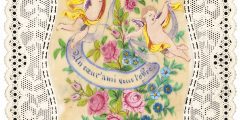
The link between St. Valentine’s Day and romance has existed at least since the later medieval period – but it was not until the latter half of the nineteenth century that one of its most iconic features emerged in its modern form: the Valentine’s Day card. Traditionally, Valentine’s Day had been associated with poetry – …

Advocates for animal welfare: FRAME
February 9, 2024
In our previous blog in this series, ‘Advocates for animal welfare: The Three Rs’, we introduced the ‘The Principles of Humane Technique in Experiments on Animals’ by William M.S. Russell and Rex Burch, which was to have such an impact on the career of Michael Balls, OBE, Emeritus Professor of Medical Cell Biology at the …
Working with the Mining Collections
February 5, 2024
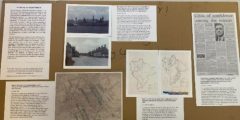
This is a guest post by Owen Coller, who volunteered at Manuscripts and Special Collections between October and November 2023, as part of the Nottingham Advantage Award scheme. As a humanities student, the opportunity to explore a collection of 19th and 20th century sources through the Nottingham Advantage Award was both a daunting and exciting …

Politics Gets Personal
January 25, 2024
Diaries can make exceptionally rewarding reading: they are intensely subjective, inward-looking narratives, and yet can also provide a window onto times gone by, capturing everyday experiences and sudden cataclysms alike. This duality is perhaps captured nowhere so well as in the Diaries of the 4th Duke of Newcastle, which date between 1822 and 1850, and …
Find, follow, join us


